cat agent | less
Deep Dive into Agents
How agents work and how they're built.
Han Cheol Moon · August 2026
why we're here
What this talk is for
- How does an agent work?
- Why do agents feel different?
- Which approach fits my work?
What it is not
Prompt tips, a model leaderboard, a hands-on tutorial.
The goal: understand what each harness keeps fixed, what it makes replaceable, and which approach fits your work.
before we start
Three things to hold loosely
A snapshot of a fast-moving field.
Dated August 2026
These harnesses ship weekly. Flags, defaults, and whole features change.
Claude Code internals: a leaked build
Its core is closed. Anthropic has not confirmed it.
One eval, not a leaderboard
30 tasks, one model, pass/fail — and not every harness on the same settings. Stars measure attention, not quality.
table of contents
Where we're going
first principles · 1/2
What is an agent, exactly?
Not a chatbot. Not a fixed script. A model that decides its own next steps toward a goal, using tools, until it's done.
Chatbot
One user turn produces one response. It may call a tool along the way, but there is no autonomous loop toward a goal.
Script
Fixed steps in a fixed order. Fast and predictable — but can't adapt when the world doesn't match the plan.
Agent
Same model — but it chooses which tool to call, when to stop, and how to recover. That choice is the whole difference.
first principles · 2/2
An agent is a model in a loop with tools
Every agent here runs the same loop:
- Call the model.
- Execute its tool calls — how it touches the world.
- Append the results to the message history — its working history for this task.
- Repeat until it stops calling tools.
while (true) {
reply = llm(messages, tools)
if (!reply.toolCalls) break
for (call of reply.toolCalls)
messages.push(execute(call))
}
the other 99%
Beyond the agent loop, Harness
Everything wrapped around that loop is called the harness.
Tools
Which tools exist, how they're described, at what "altitude" — a few primitives vs. a rich toolbox.
Context management
What enters the window and when: memory files, compaction, caching, subagent isolation.
Trust & safety
Permission prompts, approval modes, sandboxes — the UX of letting a model run commands.
Extensibility
Hooks, skills, plugins, MCP (Model Context Protocol), or deliberately no MCP at all — how users bend the agent to their workflow.
State & sessions
Transcripts, resume/fork, replay — whether you can see and reconstruct what the agent did.
Interface
TUI, GUI, headless, SDK — how humans steer, interrupt, and review.
“Everything that isn't the model is the harness — including the user.
the discipline · harness engineering · 1/2
Engineer the system around the model
"Anytime you find an agent makes a mistake, you engineer a solution such that the agent never makes that mistake again."
- Constrain with architecture, linters, and quality gates.
- Teach through tools and useful error messages.
- Record durable guidance in repository instructions.
“Add scaffolding when it helps. Remove it when the model no longer needs it.”
src: mitchellh.com/writing/my-ai-adoption-journey · anthropic.com/engineering/harness-design-long-running-apps
the discipline · harness engineering · 2/2
The harness is worth 7–10 benchmark points
Same model weights, different harness. The scores move dramatically.
2026, "Stop Comparing LLM Agents Without Disclosing the Harness." Benchmark leaderboards are increasingly harness leaderboards.
src: arxiv.org/abs/2605.23950 · futureagi.com coding-agent harness benchmark
harness anatomy · 1/7
One tool for everything, or one tool per job
Who defines what the agent can do: the model or the harness?
The model chooses the command
rg 'API_KEY' src/npm testrm -rf build/
npm test looks simple, but package.json decides what actually runs.
Flexible, but harder to predict.
The harness limits the action
Grep("API_KEY", path="src/")
This tool can only search. It cannot install or delete anything.
Limited, but easier to control.
A dedicated tool reduces what the model can ask to do.
harness anatomy · 2/7
What each access model costs
Restricting access buys control and pays for it elsewhere. Itemized:
Broad access · Bash | Restricted access · Grep | |
|---|---|---|
| Control | Coarse — the same tool can also download or delete | Precise — this tool can be search-only |
| Reliability | Model must write valid, platform-specific syntax | Harness validates inputs and can normalize behavior |
| Context rent | One general tool description, reused for everything | Another schema loaded on every request |
| Build cost | None — the shell already exists | Code to write, test, and maintain per platform |
This is why no harness picks one: you promote an operation to a dedicated tool when it is frequent or dangerous enough to be worth the rent.
harness anatomy · 3/7
The window is the agent's working memory
If the model needs to use something now, it must be in context. The window is finite, so the harness decides what enters, when, and at what detail.
Reuse the stable prefix
System prompt, tools, and earlier turns stay identical — process them once, then reuse the cached work.
Summarize old turns
Replace a long history with shorter notes. It buys space, but compression is lossy.
Send work to a subagent
Let a child search thousands of lines; return only its conclusion to the main conversation.
Put durable facts in files
CLAUDE.md or AGENTS.md is loaded again on later requests, surviving conversation compaction.
Cache what repeats. Compress what ages. Delegate what sprawls. Persist what must survive.
harness anatomy · 4/7
Permission asks. A sandbox constrains.
One depends on judgment before the action. The other limits the process while it runs.
“Can I do this?”
A human or classifier decides each time. Repeated prompts create permission fatigue: eventually, every answer becomes yes.
“This is all you can touch.”
Inside the boundary → run without asking
Cross the boundary → block or request permission
The OS enforces this boundary over files, network, and processes.
The sandbox is the safety layer that survives bad judgment.
harness anatomy · 5/7
Four extension mechanisms, four different jobs
Each mechanism extends the agent in a different way.
Example — staging deployment
Checks a rule before deployment
When the agent requests deployment, the hook checks the branch first.
Approved → continue · Not approved → block
It still works if the model forgets the rule.
Adds specialized instructions
Teaches the agent how to perform a task. Example: explain your company's staging procedure.
Connects an external system
Exposes an external capability as a tool. Example: provide deploy_to_staging from a deployment platform.
Bundles extensions together
Distributes skills, MCP configuration, hooks, and commands as one installable package.
They are not interchangeable: skills teach, MCP connects, hooks enforce, and plugins package.
harness anatomy · 6/7
Sessions: save, continue, branch, replay
A session is one episode of work: messages, tool calls, and results. What the harness saves determines what you can do afterward.
What exactly happened?
Save prompts, replies, commands, and results. Human-readable text helps review; JSONL (one JSON object per line) also enables search, analysis, and replay.
Pick up tomorrow
Reload the previous history and continue with its context instead of explaining the task again from scratch.
Try another path
Copy the conversation at an earlier point, then explore a different solution. It branches the session, not necessarily the Git repository.
Review or reproduce it
Walk through saved messages and results, or feed the same inputs back through the loop. Re-running actions needs care: side effects may happen twice.
Save it → inspect it, continue it, branch it, or replay it.
harness anatomy · 7/7
Interface: where does the loop run?
The agent loop stays the same. What changes is who starts it, who watches it, and how another system controls it.
TUI or GUI
A person types requests, watches each step, approves actions, and can interrupt mid-turn.
Script or CI job
No interactive screen and often no person watching. Inputs arrive through flags or standard input; results go to logs or files.
Inside another app
Program code starts sessions, sends prompts, receives events, and presents the agent through its own product interface.
Same loop. Three control surfaces.
deep dive · claude code · 1/6
Claude Code — bet on the model
- Keep the core close to the model — low-level, flexible, and relatively unopinionated.
- Remove scaffolding as models improve — Anthropic reports cutting the system prompt by roughly half and pruning tools across generations.
- Build with the product itself — creator Boris Cherny reported that Claude Code wrote about 90% of its own code.
src: anthropic.com/engineering/claude-code-best-practices · Pragmatic Engineer "How Claude Code is built"
deep dive · claude code · 2/6
How it works: the turn cycle and its history
Every turn runs the same three steps, and everything the agent learns lands back in one linear active history — the loop reads from it and appends to it, turn after turn.
- Single-threaded master loop — explicitly not a multi-agent swarm; debuggability wins.
- LLM search over RAG: no vector index — the agent greps the repo like a human, so results reflect the files as they are right now.
- Planning is model-maintained: the agent writes its own task list, re-injected after tool calls to fight context drift.
src: code.claude.com/docs (agent loop) · minusx.ai/blog/decoding-claude-code · *mid-2025 measurement
deep dive · claude code · 3/6
One loop, parallel tools
"Single-threaded" describes who decides. "Parallel" describes what runs once a decision is already made.
Tool execution can fan out
Every call in that fan-out was requested by the same single reply. Results converge back into the one history before the next model call.
The decision itself never forks
A multi-agent swarm runs independent loops, each with its own context and its own judgment call — no shared history to converge into.
Parallel I/O, singular judgment.
deep dive · claude code · 4/6
A toolbox with strict rules
The rules are the point: each tool either does exactly what it promises, or refuses and explains what to fix.
- Edit replaces exact text. It refuses to run when the file has not been read, the target text is missing, or that text appears more than once.
- Read adds line numbers, so the model can point at specific code before changing it — and so
Edithas something unambiguous to match. - A refusal carries the fix. Not "invalid input" but which precondition failed and what to do about it — the error is the next prompt.
Model: replace 3000 with 5000
Edit stops: Found 4 matches.
I will not guess which one.
Model: read the file, include the
surrounding function, and retry.
Success: Changed the right line.
When an edit is ambiguous, the tool stops and makes the model be more precise.
src: code.claude.com/docs (tools reference)
deep dive · claude code · 5/6
Context management is most of the harness
The harness keeps durable rules in scoped files, then controls what the finite window retains, caches, or delegates.
- Memory rules cascade by scope. Company-wide policy, then personal preferences, then repo conventions, then rules local to a subdirectory — the applicable layers are combined for each request.
CLAUDE.mdrides in the stable prefix, ahead of the conversation — so it keeps its cache hit, and compaction ages out the turns behind it without ever reaching the rules.- System reminders re-assert those rules mid-session as hidden harness notes, not user turns.
- Compaction is automatic, not a command you remember to run: old turns are summarized as the window fills.
~/.claude preferencesCLAUDE.md rulesSystem prompt = hidden instructions given at the start · system reminder = hidden instructions injected later to re-emphasize a rule or state
src: code.claude.com/docs (memory · costs) · anthropic engineering, context engineering
deep dive · claude code · 6/6
Permissions, and the sandbox underneath
Mode → rules → sandbox. Each layer answers a different question.
Mode sets the default
plan· inspect onlydefault· ask before unapproved changesacceptEdits· edit freely, ask about commandsbypassPermissions· do not ask
Rules refine the default
Choose allow, deny, or ask for individual actions.
- Allow
npm test - Deny access to
./secrets/** - Ask about other Bash commands
Sandbox limits reach
Even after permission is granted, the OS can confine the command to the workspace and control network access.
Inside the boundary → run
Outside the boundary → block or ask
Mode sets general behavior → rules handle specific actions → sandbox limits the actual damage.
src: code.claude.com/docs (iam · sandboxing) · github.com/anthropics/sandbox-runtime
deep dive · pi · 1/5
pi — start small, add what you need
Strong models already know the basic coding loop, so the harness need not decide every workflow for you.
Claude Code
Subagents, permissions, plan mode, MCP and task tracking are built into the product.
pi
Begin with essential tools. Add the workflows you want through extensions and packages.
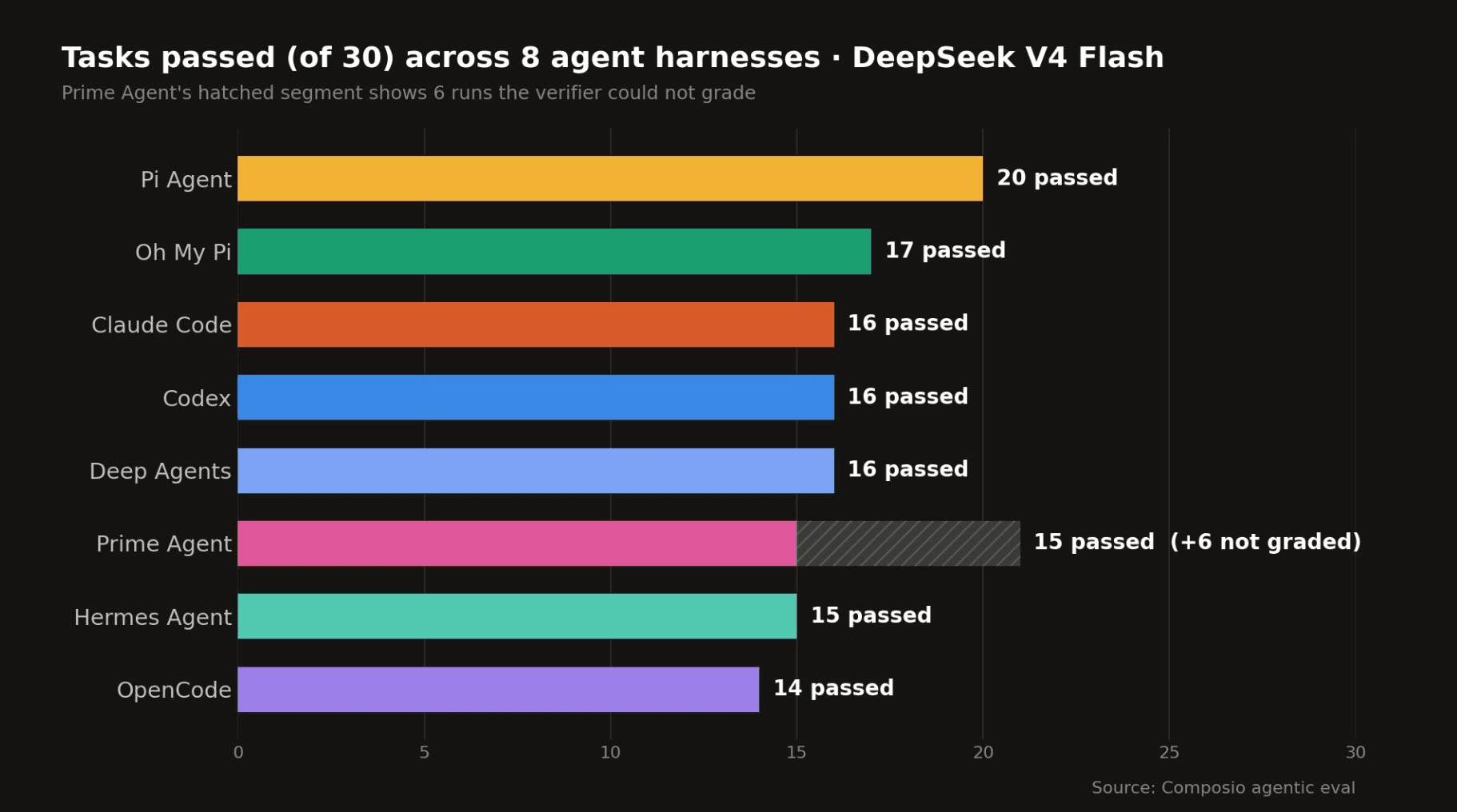
Composio Golden Eval · 30 multi-app SaaS workflows, same model for every harness. pi also posted the lowest cost per success ($0.028 vs Claude Code's $0.195), but it ran a different reasoning setting and two providers — not a clean head-to-head.
src: mariozechner.at/posts/2025-11-30-pi-coding-agent · pi.dev · composio.dev/content/best-agent-harness-deepseek-v4-flash (Aug 2026)
head to head · claude code vs pi
Claude Code provides; pi lets you choose
Both keep the model at the center. They differ in how much supporting machinery is included by default.
Claude Code · ready out of the box
Subagents, context management, permissions, sandboxing, and extension points are already built in.
Benefit: less setup for teams, CI, and long autonomous tasks.
Trade-off: the closed core makes more decisions for you.
pi · start small
One main agent loop runs by default. Subagents, permission gates, sandboxing, and custom UI can be added through extensions.
Benefit: the open core stays visible and under your control.
Trade-off: you choose and maintain more of the setup.
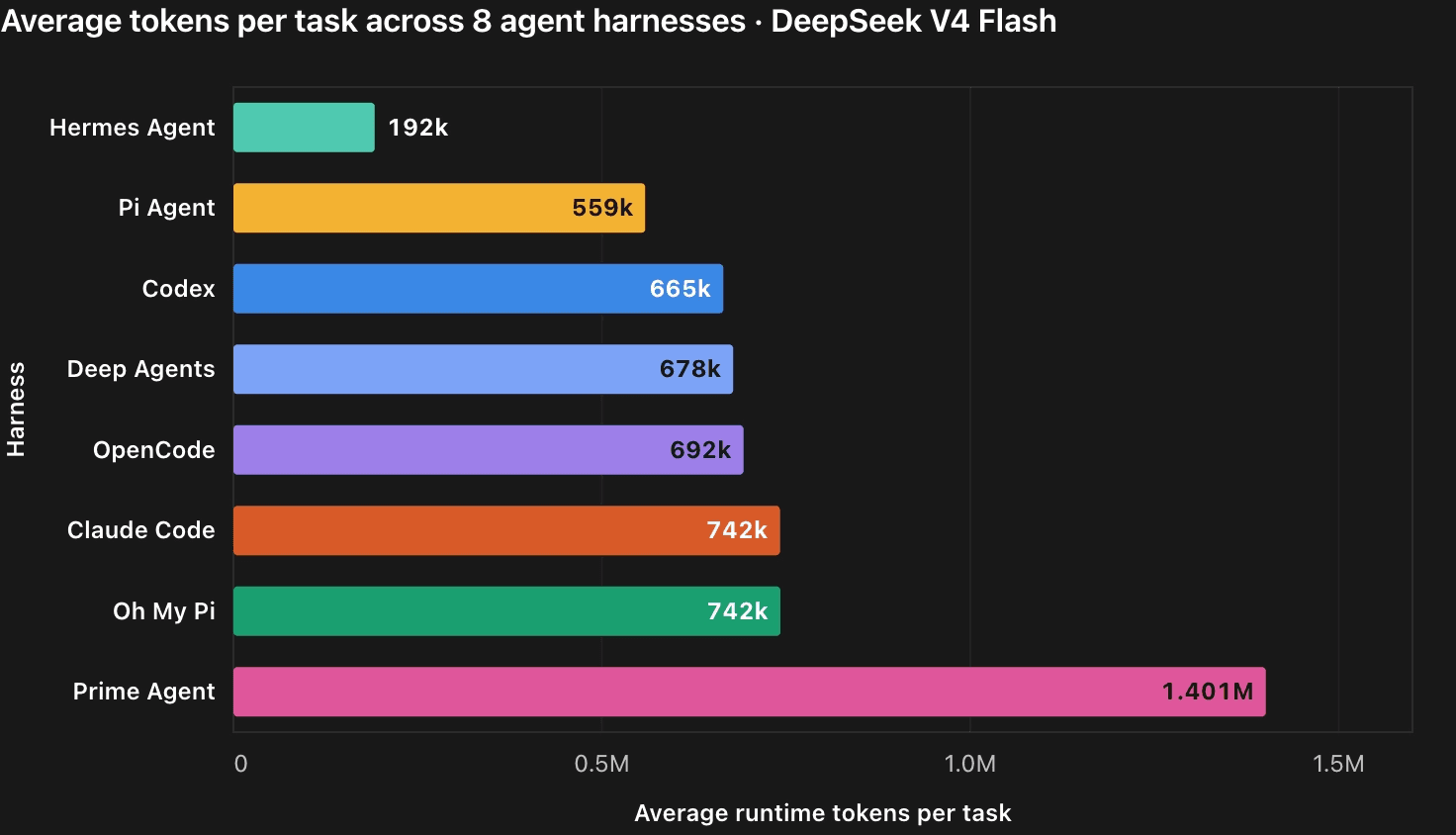
What the two philosophies cost in practice — pi 559k tokens per task, Claude Code 742k. Thinner spends less, though Hermes at 192k shows thinness is not the only lever.
deep dive · pi · 2/5
Same capability, different visibility
Pi can compose general tools to do most jobs. Dedicated tools usually add structure for the harness, not new ability for the model.
General tools have broad reach
curl reaches the web. Markdown stores todos. A subprocess can run another agent. grep and find search the repository.
A small toolbox can still solve the task.
Dedicated tools reveal intent
Grep(pattern="API_KEY")
known: search only, read only
Bash("grep -R API_KEY src")
known: a general command that must be inspected
Run safely in parallel
The harness knows read-only calls cannot change files, so it can execute several at once.
Apply precise permissions
It can allow a search-only tool without also granting the power to modify or delete.
Render structured interfaces
It can validate and display plans, todos, questions, and edits as purpose-built UI.
Safety trade-off: pi's default Bash exposes a wider action space, and its core has no per-tool permission gate. That does not make pi inherently unsafe, but lower-trust work should use a permission extension or run inside a sandbox or container.
Claude Code ships more structure by default. Pi lets you add it when you need it.
src: github.com/earendil-works/pi (core/tools/index.ts · core/sdk.ts) · pi README
deep dive · pi · 3/5
Four active by default; seven available
- Seven tools ship; four are active by default:
read·write·edit·bash.grep,findandlsare implemented but stay off unless you enable them — bash already covers them. - System prompt + tool definitions < 1,000 tokens (vs. multi-thousand for the big harnesses). Nothing injected behind your back — but that is the fixed cost only: with no subagent in core, whatever the model reads stays in the one history.
- Loop is a streaming async generator; partial-JSON parsing paints live diffs as tool calls stream in.
- Sessions are JSONL trees — a documented public format: branch, fork, replay, post-process. Switch model/provider mid-session with full context handoff.
- No built-in permissions or sandbox by design — isolate it with a Docker/Podman container or an OS sandbox such as bubblewrap. The one gate is project trust: a single prompt per folder, before pi loads its settings, installs its packages, or runs its extensions.
src: github.com/earendil-works/pi (core/tools/index.ts · core/sdk.ts) · pi README · mariozechner.at/posts/2025-11-30-pi-coding-agent
deep dive · pi · 4/5
The core stays small; extensions add the rest
That includes MCP: not rejected, simply added only when needed.
Extensions add capabilities
Pi loads TypeScript extensions at startup. They can add tools, commands, permission gates, and UI, and can be shared as pi packages.
An extension is ordinary code running as you. It can read files, use the network, and execute commands, so install only sources you trust.
Not built in does not mean unavailable
By default, pi reaches existing CLI tools through Bash. They already compose through pipes, files, and scripts.
MCP standardizes external tool connections, but its schemas consume context. Users who need it add MCP through an extension.
One example, not a universal ratio; modern clients defer schemas.
Pi does not reject MCP; it makes the context cost opt-in.
src: pi README · docs/extensions.md · mariozechner.at/posts/2025-11-02-what-if-you-dont-need-mcp
deep dive · pi · 5/5
Why a small local model gets on with pi
A model on your own GPU arrives with a short context window and slow tokens. A harness that spends thousands of both before you type is the wrong tenant.
- The floor is low. System prompt plus tool definitions stay under 1,000 tokens — roughly 3% of a 32k local window. A multi-thousand-token preamble with twenty tool schemas can claim a fifth of it before the first file is read.
- A small, familiar tool surface.
readwriteeditbash, withgrepfindlsalongside. A weaker model picks correctly far more often from a short list it has seen a million times than from twenty bespoke schemas. - Fewer tokens spent getting there. Composio measured pi at 559k average runtime tokens per task against Claude Code's 742k. On a local GPU that gap is wall-clock, not cents.
- An escape hatch when the small model stalls.
/modelre-reads the config mid-session, so a local model can hand one hard turn to a frontier one with the history intact.
{
"providers": {
"ollama": {
"baseUrl": "http://localhost:11434/v1",
"api": "openai-completions",
"models": [{ "id": "qwen3-coder:30b" }]
}
}
}
LM Studio and vLLM are the same shape — any OpenAI-compatible base URL. Four dialects are recognised, so Anthropic and Google endpoints sit in the same file.
The matching caveat: pi ships no permission gate, so bash runs unprompted. That is a fair trade with a frontier model and a poor one with a 7B that hallucinates a path — add the permission extension, or keep it in a container.
src: pi.dev/docs (models) · composio.dev agentic eval (Aug 2026) · patloeber.com/gemma-4-pi-agent
head to head · claude code vs pi
Spec by spec
| Claude Code | pi | |
|---|---|---|
| Core tools | ~15 built-ins (Read, Edit, Bash, Grep, Glob, Agent, Skill, Web…) | 4 active — read, write, edit, bash (7 implemented; grep/find/ls off by default) |
| Prompt overhead (fixed) | multi-thousand tokens (system prompt + tool schemas) | < 1,000 tokens total |
| Context management (variable) | auto-compaction, hidden reminders, subagent isolation | nothing injected invisibly — but exploration lands in the one history |
| Subagents | built-in Agent tool, fresh context per subagent | not in core — shipped as an example extension |
| MCP | yes, schemas deferred to save context | not in core by design — CLI tools + bash instead; an extension adds it |
| Extensibility | hooks · skills · plugins · marketplaces | hot-loaded TypeScript extensions · skills · packages |
| Sessions | resume/fork; internal format | documented JSONL trees — branch, replay, post-process |
| Safety | permission engine + bash AST screening + OS sandbox | no per-tool gate — project trust once per folder; sandboxing is your container's job |
| Models | Claude only (Bedrock/Vertex routing) | any — 15+ providers, switchable mid-session |
| Source | closed, minified bundle (SDK + sandbox open) | MIT core, readable in an afternoon |
Rule of thumb: Claude Code when you want maximum capability out of the box; pi when you want to see — and own — every token.
deep dive · opencode · 1/3
opencode — familiar UX, open architecture
An open-source coding agent with Claude Code-like ergonomics — and 200k+ GitHub stars.
The same working rhythm
plan / build, discovery subagents, AGENTS.md, /init, skills, MCP, hooks and permission prompts.
Three structural bets
Any model — 75+ providers.
Server-first — many clients.
Config-first — agents and policy are files.
src: github.com/anomalyco/opencode (200,363★, Aug 23 2026) · opencode.ai/docs · counts change weekly
deep dive · opencode · 2/3
One server, many clients and models
Clients come and go
opencode starts the TUI and server together. Run opencode serve standalone and it stays alive when a TUI disconnects; clients reconnect through OpenAPI.
Models are replaceable too
75+ providers via models.dev, including local models. Optional LSP (Language Server Protocol) feedback adds code intelligence; it is off by default.
The same core runs in CI
opencode run --format json scripts it. GitHub integration executes in your Actions runner, not a vendor cloud.
Zen sells optional model access; the MIT harness remains complete without it.
src: opencode.ai/docs/server · /providers · /lsp · /cli · /github · /zen
deep dive · opencode · 3/3
Configuration is the product
Primary agents: build has full access; plan asks before edits or bash. Switch with Tab.
Subagents: explore reads your code; scout reads dependencies. Call them with @; discovery stays in a child session.
Every agent can set its own model, prompt, step limit and permissions. Each permission is allow, ask or deny.
Sensitive repo? Disable sharing and use a container for hard isolation; there is no built-in OS sandbox.
Reveal tools only where needed
"permission": { "playwright_*": "deny" },
"agent": {
"e2e": { "permission": { "playwright_*": "allow" } }
}
Only e2e sees Playwright's schemas: less context, less tool noise.
Easy migration
AGENTS.md is native, but OpenCode also reads existing CLAUDE.md rules.
src: opencode.ai/docs/agents · /permissions · /tools · /rules · /share · source: session/llm/request.ts
rising star · deepseek harness · 1/4
DeepSeek Harness (dsh)
An open agent runtime released with V4-Pro on August 13, 2026. Its thesis: Model + Harness = Agent.
- Everything is replaceable — even the agent loop.
- Model-agnostic — 40+ provider adapters, plus delegation to Claude Code or Codex CLI.
- Built for experimentation — Web UI, CLI and Python SDK over a TypeScript/Node core.
185k+ stars in ten days; impressive attention, not proof of maturity.
src: github.com/deepseek-ai/deepseek-harness (185,162★, Aug 23 2026) · thenewstack.io · counts change quickly
rising star · deepseek harness · 2/4
Even the loop is a plugin
Fixed loop vs. replaceable loop
Most coding agents bake in model → tool → result → repeat. DSH makes that orchestration a replaceable component, alongside models, tools, storage and sandboxes.
Event-driven execution
turn/start → step → tools/execute → turn/end. At each boundary a plugin can observe, modify, reject or replace work — add approval, verification, tracing, or a different next-step policy.
Replayable sessions
An append-only event log preserves what the model saw and did. Resume, fork and replay use the same history; compaction becomes a replaceable view, not lost evidence.
Four run modes
Standard: full runtime · Minimal: bash + editor, lower overhead · PTC (programmatic tool calling): generated TypeScript batches tool calls, fewer round trips · Creation: builds agent components.
The loop is no longer a hidden constant; it is part of the experiment.
src: thenewstack.io "DeepSeek Harness open source plugins" · justin3go.com review (Aug 15)
rising star · deepseek harness · 3/4
Other harnesses choose a philosophy. dsh makes it a mode.
A rough analogy, not equivalence: DSH can reproduce familiar tool philosophies, then go beyond them.
Rich, fixed product
Closest to DSH Standard: a complete runtime with a broad tool surface. Claude Code exposes extensions, but Anthropic owns the core loop.
Small, fixed core
Closest to DSH Minimal: bash and editing with little overhead. In pi, minimalism is the product philosophy; in DSH, it is one selectable mode.
Configurable surface
Agents, models, tools and permissions are configurable around a server loop. DSH goes deeper: plugins can replace the loop and intercept every stage.
The harness is the variable
Standard or Minimal for familiar workflows; PTC to program the work; Creation to program the agent. Every run remains replayable.
Others ask: which harness? · DSH asks: which harness behavior for this run?
comparison synthesized from each project's docs · mode analogy is explanatory, not a compatibility claim
rising star · deepseek harness · 4/4
Promising, not yet a daily driver
Why it matters:
- MIT-open and inspectable.
- Model-portable and fully replayable.
- A research platform for harness engineering.
Why wait:
- Its v0.1 preview warns of breaking changes.
- One early review measured ~47.6k tokens of context overhead, partly from bugs.
- Integration coverage and vendor benchmarks still need independent verification.
Best viewed today as an open harness laboratory, not a finished coding product.
src: github.com/deepseek-ai/deepseek-harness · justin3go.com review (Aug 15) · docs.bswen.com "DeepSeek Harness vs Pi"
deep dive · hermes · 1/4
Hermes — the agent that remembers
Everything so far was organized around code. Nous Research's personal agent shifts the center to memory and self-improvement.
- Persistent: it carries curated memory, user preferences and reusable skills across sessions.
- Runs anywhere: local, Docker, SSH or four cloud/HPC backends. Daytona and Modal hibernate when idle.
- Model-agnostic: use major providers, compatible endpoints or the optional Nous Portal bundle.
The bet: an agent should become more useful the longer you use it.
src: github.com/NousResearch/hermes-agent · hermes-agent.nousresearch.com/docs (architecture, providers)
deep dive · hermes · 2/4
Not an open Claude Code
Hermes can write code, but it sits closer to OpenClaw — a messaging-first personal agent that stays available — than to a repository-first coding assistant.
Organized around a repository
Terminal and IDE · task-oriented sessions · inspect, edit, test.
Organized around a person
Messaging gateway · persistent memory · scheduled work · remote execution.
Claude Code: inspect → edit → test · Hermes: remember → automate → communicate
hermes claw migrate makes the intended migration path explicit: it imports OpenClaw personas, memories, skills, messaging settings and allowlists.
src: Hermes README · README "Migrating from OpenClaw" · hermes claw migrate
deep dive · hermes · 3/4
A learning loop around the agent loop
Skills become procedures
After complex work, Hermes can create a reusable skill and improve it during later use. Skills follow the portable agentskills.io format.
Memory becomes personal
MEMORY.md and USER.md persist what matters. Honcho models the user across sessions; SOUL.md defines the agent's identity.
Past sessions stay searchable
SQLite with its FTS5 full-text index provides full-text recall. Long conversations are compressed while session lineage is preserved.
Work continues unattended
Subagents isolate parallel work, Python can batch tool calls, and cron jobs deliver results to messaging platforms.
Experience → memory or skill → better behavior next time.
src: docs/developer-guide/architecture · docs/user-guide/features/{skills,memory,cron,honcho}
deep dive · hermes · 4/4
Available everywhere; isolated when it matters
One gateway, 25+ adapters. Message Hermes through Telegram, Discord, Slack, WhatsApp, Signal, Teams, email and more while it works on another machine.
Defense in depth
smart / manual / off command approval sits above an unoverrideable blocklist. Hermes also protects credential paths, filters secrets and scans context files for prompt injection.
Hard isolation
Container backends use minimal capabilities and no-new-privileges. Inside them, command approval is skipped because the container is the boundary.
Know where the boundaries are:
- Write guards protect
write_fileandpatch, not the shell. - Local and SSH backends are not sandboxes.
- Deny rules target an honest-but-wrong agent, not hostile code.
For unattended or messaging use, run Hermes in Docker or a cloud sandbox rather than directly on the host.
src: docs/user-guide/security · docs/user-guide/messaging · docs/developer-guide/architecture
my take
Same mechanics, different beliefs
The products look alike because the mechanics converge. They feel different because each puts intelligence, control and trust in a different place.
A common blueprint
Model in a loop · tools · context management · sessions · permissions or isolation · extension points.
A philosophy of the harness
Is the model the product or a setting? Should the harness shrink, be configured, or be replaced? What persists? Where is the trust boundary?
An agent is not only model + tools. It is a theory of where the intelligence should live.
side by side
Five harnesses, five centers of gravity
| Claude Code | pi | opencode | dsh | Hermes | |
|---|---|---|---|---|---|
| Product center | finished coding agent | transparent, ownable core | agent server | harness laboratory | persistent personal agent |
| Loop | fixed, closed | fixed, minimal | fixed + plugin hooks | replaceable plugin | fixed execution + learning layer |
| Models | Claude only | any (15+) | any (75+) | any (40+) | many; 300+ through Portal |
| Tool philosophy | rich built-ins + MCP | 4 core tools, bash-first | built-ins + MCP + LSP | plugins + selectable modes | 70+ toolsets + MCP |
| Context | managed for you | explicit, user-controlled | server sessions + subagents | append-only event log | memory + SQLite/FTS5 |
| Hard isolation | built-in OS sandbox | bring a container | none — permissions only | plugin-dependent | container backends |
| Signature bet | model capability | minimalism + ownership | configurable server | replaceable harness | improves over time |
Simplified comparison, Aug 2026 — each project overlaps more than one category.
exit code 0
Takeaways
- The loop is tiny; the system around it decides the result — worth 7–10 benchmark points on identical weights.
- Claude Code and pi are opposite fixed-loop bets: a rich product versus a deliberately small core.
- opencode makes the model, interface and policy configurable. dsh goes one layer deeper and makes the loop itself configurable.
- Hermes changes the target: not a repository-first copilot, but a persistent agent organized around a person.
- Do not ask only which model? Ask what should be fixed, what should be replaceable, and where is the trust boundary?
exit
man agent —help
Questions?
exit 0
Thanks
Han Cheol Moon
https://han8931.github.io